
Which work light for which job? Lumen vs watt, Kelvin, CRI, IP rating and placement tips, plus STALCO headlamps, work la...

Your online building supplies store for building and renovation
 English
✓
English
✓
 Nederlands
✓
Nederlands
✓
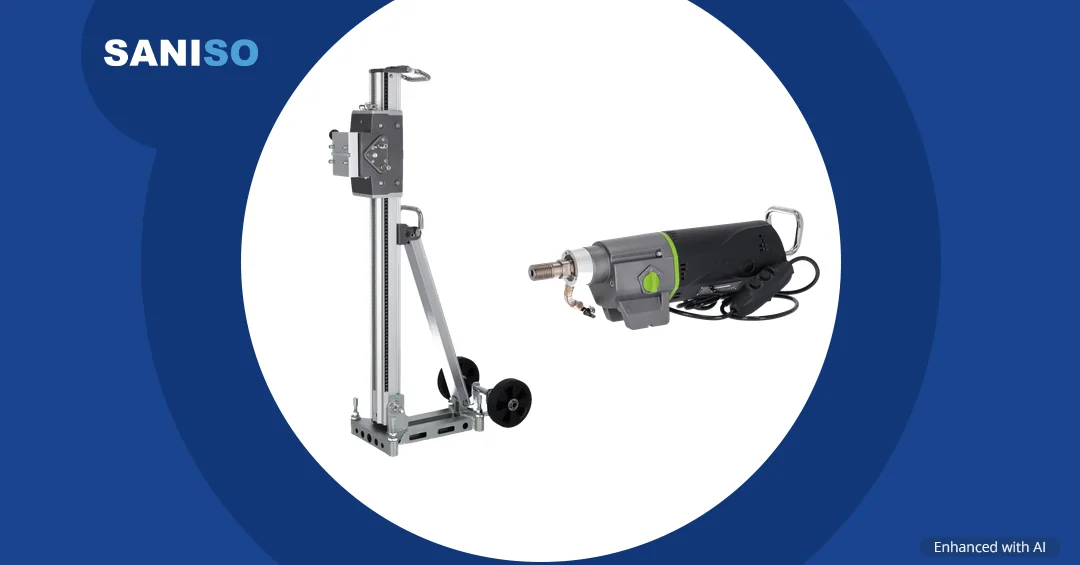
Large, deep or precise holes in concrete or masonry are not drilled by hand. Mount the drill motor on a stand first, anchor it, and only then start drilling. That keeps the bit straight, lets the stand absorb torque if the bit binds, and gives you better control of water and dust.
Stalco Perfect supplies diamond drills, stands, anchors and water feed for that fixed setup at Saniso. Saniso B.V. in Zwaag sells the Stalco Perfect brand as a wholesaler and webshop.
A fixed setup is a drill motor on a column stand, secured to floor or wall. The bit cuts out a round core; you remove that core once the hole is finished. That is how you make through-holes in floors and walls for drains, ducts or pipework.
Handheld work is finer for small diameters. As soon as the diameter grows, the depth increases or you have to go through reinforced concrete, the stand wins. The machine follows the column, not your arm. You keep both hands free for water, feed and control.
Manufacturers often list a smaller handheld diameter than the diameter with a stand. On the DDP202, for example, that is 162 mm handheld and 202 mm on the stand.
This method suits installers, renovation tradespeople and concrete drillers who make through openings. On complex or load-bearing structures, many teams bring in a specialist. The stand also helps anyone who occasionally needs a large hole, provided the setup is right.
Choose diameter, wet or dry, and the spindle thread of your bit first. Then choose the motor.
The DDP402 is the heavy wet drill for large diameters. The DDP202 and DBP202 cover the mid-range; the DBP202 has micro-impact. The DBP132 is a separate dry line with M18 — it does not fit SHARK bits with 1¼″.
Both DDP models have a safety clutch. The DDP202 also mentions an RCD on the product page. Check the manual for which stand and diameter belong with your machine.
The DRP202 fits machines up to 202 mm. Column 60×62×850 mm, stroke 510 mm, tilt 0–45° with spirit level, about 11.5 kg. The product page lists compatibility with the DDP202.
The DRP402 belongs with larger diameters up to 402 mm. Heavier column, tilt up to 45°, wheels, about 18.5 kg. The DDP402 lists this stand as a matching partner.
Level the stand before you start. A skewed column gives a skewed hole, a binding bit and a higher risk of jamming.
The stand must be secured first, then you switch the machine on. At Saniso that means the Tripod Anchoring Set: M12×180 bolts and washers for fixing to a load-bearing substrate.
Choose an anchor that matches the substrate and follow the instructions for both anchor and stand. Chemical or mechanical: that depends on concrete, calcium silicate brick or masonry — there is no universal size for every floor.
Some brands work with a vacuum base on a smooth, clean, non-porous surface. On tiled or porous layers, vacuum often will not hold. For horizontal drilling that method needs extra securing; drilling upwards needs solid anchor securing.
On the Stalco Perfect stands you anchor with the Tripod Anchoring Set.
In reinforced concrete you drill with the SHARK bits wet only. Unreinforced concrete, brick or Porotherm can be wet or dry, depending on bit and machine. The DDP402 is wet-only in any case.
The Hydronetka is a pressure vessel of nominal 10 litres (13 litres total), working pressure 1.7–3.8 bar, with pressure gauge and quick coupling. That feeds water to the bit without loose garden-hose clutter.
Water alone is not enough. Collect slurry and extract it wet, so sludge does not dry out and later become airborne again. When drilling upwards, water management is even more critical: think of collection plus a wet industrial vacuum, and work with a functioning RCD.
Large-diameter bits, such as the SHARK diamond core bit ø102 × 450 mm, connect on 1¼″. The range runs up to ø400 mm.
Too high an rpm on a large bit wears segments faster and raises the chance of jamming. Use the gear tables on the product page.
| Machine | Gear 1 | Gear 2 | Gear 3 |
|---|---|---|---|
| DDP202 | approx. 650 rpm · ø202 mm | approx. 1300 rpm · ø102 mm | approx. 2600 rpm · ø62 mm |
| DDP402 | approx. 350 rpm · ø402 mm | approx. 700 rpm · ø202 mm | approx. 1100 rpm · ø102 mm |
Centre lightly first, then apply feed. If the bit binds: do not force it, stop and free the jam according to the manual.
If you hit steel, reduce the feed. Diamond will cut through reinforcement, but cutting a structural bar in a load-bearing floor, column or wall can reduce load capacity. If you are unsure about a load-bearing element: consult the structural engineer. Check for services beforehand as well.
On floor through-drills: secure whatever can fall below — including the core itself.
Drilling in stone-like materials produces respirable crystalline silica. Wet drilling and extraction reduce exposure at source. Personal protection (eye, hearing, gloves, suitable respiratory protection) remains additional. Sweeping dry slurry later is a classic mistake: the dust is then released again.
On small diameters and light work, within the handheld limit of your machine. Once the hole becomes larger, deeper or more precise — or you work in heavily reinforced concrete — the stand belongs with it.
The DDP202 (2200 W) goes to 202 mm on the stand and can do wet and dry. The DDP402 (3300 W) goes to 402 mm and is wet only. Larger openings need the heavier set with the DRP402.
In reinforced concrete yes, with the SHARK bits. The DDP402 runs wet only anyway. Unreinforced material can sometimes be dry, but water cools the bit and dampens dust. Combine water feed with collection and wet extraction.
Not as the sole fixing. Drilling upwards needs solid anchor securing. Vacuum is a method on a suitable smooth substrate, with extra securing on horizontal work — not a substitute for anchors when going upwards.
Follow the table on the product page: on the DDP402, ø202 mm belongs with gear 2 (about 700 rpm). On the DDP202, ø202 mm is gear 1 (about 650 rpm). Exact values are on the product page and in the manual.
Reduce feed, do not force it. On load-bearing parts: stop and consult the structural engineer before you cut structural steel.
Contact: Saniso B.V., De Corantijn 95, 1689 AN Zwaag · +31 85 488 5920 · [email protected] · Contact.
Share:
Which work light for which job? Lumen vs watt, Kelvin, CRI, IP rating and placement tips, plus STALCO headlamps, work la...
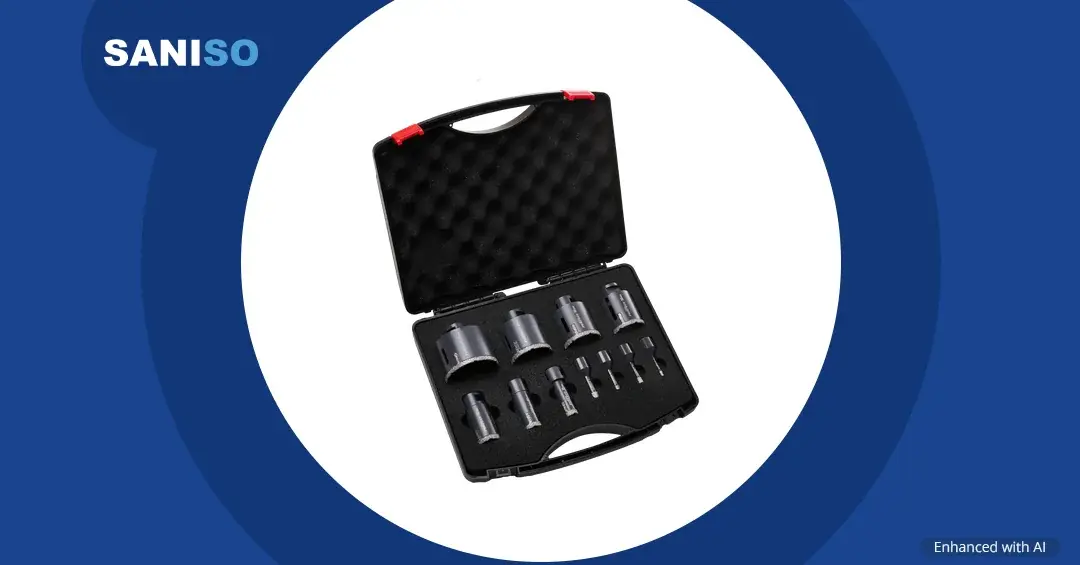
How to drill with a diamond bit or hole saw in tile, concrete or masonry? Bit choice, fitting and tips. Stalco at Saniso...
Tool trends 2024–2026: battery platforms, ergonomics, dust-free work and large-format tiles. A guide for tradespeople vi...
Choose STALCO painter’s masking tape, plastering tape and protective foil for clean paint lines and covered floors at Sa...