





Work gloves need to protect, but you also want to be able to pick up a small screw. In this blog we look more closely at...

Your online building supplies store for building and renovation
 English
✓
English
✓
 Nederlands
✓
Nederlands
✓

On an average building site you hear machines all day: an angle grinder, a circular saw, a breaker, a hammer drill or a concrete mixer. Many of those sounds are well above the level at which your hearing is damaged. The treacherous thing is that hearing damage develops slowly, does not hurt and does not recover. Ringing ears after a working day are a warning. In this blog you will read how to choose the right hearing protection and how to wear it so that it really protects you.
👷 Good hearing is more than comfort for a professional. You hear a machine that sounds different, a colleague shouting a warning or a vehicle reversing. Craftsmanship also means protecting your own tools, and your hearing is one of them.
In the Netherlands, three limits from the Working Conditions Decree apply to noise at work, measured as an average over an eight-hour working day:
A rule of thumb on site: if you have to raise your voice to be understood by a colleague at arm's length, you are probably above 80 dB(A). When grinding, sawing, breaking or working with a hammer drill or a 125 mm angle grinder you quickly go far above that.
⚠️ Decibels do not simply add up. Three dB more means roughly a doubling of the sound energy. That is why the time you may work unprotected becomes much shorter at higher levels.
According to the occupational hygiene strategy, you tackle noise at the source first. Choose quieter machines and working methods, keep tools well maintained, screen off noisy workplaces and plan noisy work so that as few people as possible are nearby. Hearing protection is the last step, but on most building sites it is an essential one. General rules for working safely are in our blog on safe working on the construction site.
Both protect well, as long as you choose and wear them correctly.

The SNR (Single Number Rating) indicates in one figure how many decibels a hearing protector attenuates on average. A few points to note:
The best hearing protection is the one you wear all the time. A few minutes without protection in loud noise can already be a large part of your daily dose.
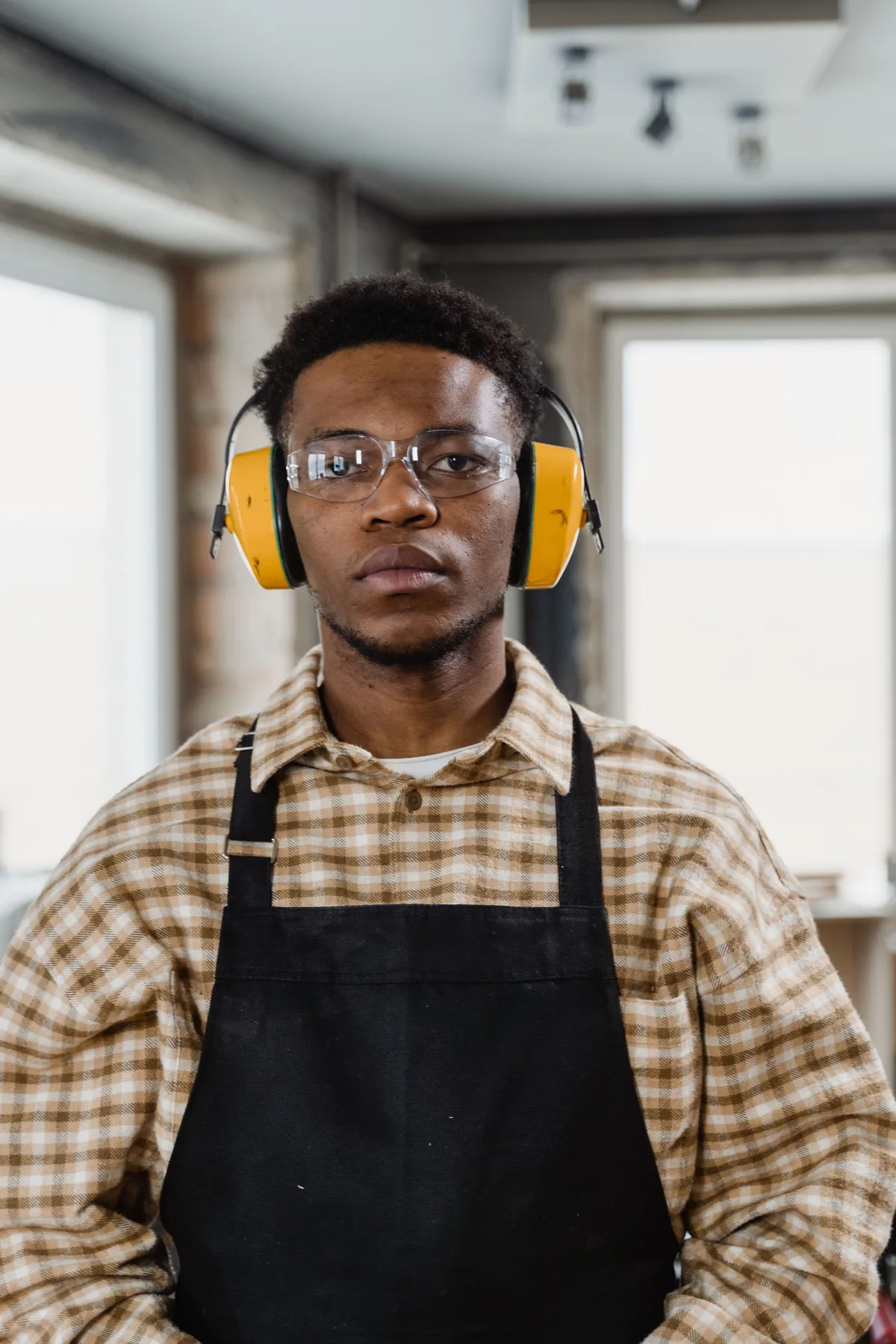
Hearing protection must work together with the rest of your equipment. Helmet-mounted cups prevent a headband from pushing the helmet out of position. Read more about choosing a helmet in our blog on safety helmets for professionals. A general explanation of hearing protection when grinding, sawing and breaking is in our blog on hearing protection.
If you notice any of these signs, have your hearing tested via the company doctor or your GP. Acting in time prevents the damage from getting worse.
Read also: Safety glasses for tradesmen and tradeswomen, Safety footwear S1, S1P, S2, S3 explained and How to choose safety shoes: S1P, S3 or S5?.
Choose hearing protection intended for work and with a known attenuation, such as earplugs and earmuffs with a stated SNR value.
Preferably not. Music adds noise and you hear warnings less well. Follow the agreements at your workplace.
Check the cushions and headband regularly. If cushions are hard, torn or no longer seal properly, replace them. Follow the manufacturer's instructions.
At Saniso, the online store for DIYers and professionals, you will find tools, materials and personal protective equipment for your job.
In doubt about the approach? Feel free to call in a professional.
Saniso – Build your home with Saniso.
Share:
Work gloves need to protect, but you also want to be able to pick up a small screw. In this blog we look more closely at...

Which safety glasses suit your work? Read what to look for in impact resistance, sealing and comfort, when to combine gl...

Sawing, grinding, drilling and chasing in concrete, masonry, tiles and natural stone releases fine quartz dust. After ye...
A safety helmet protects your head against falling objects and bumps, but only if it fits, is adjusted properly and is r...