





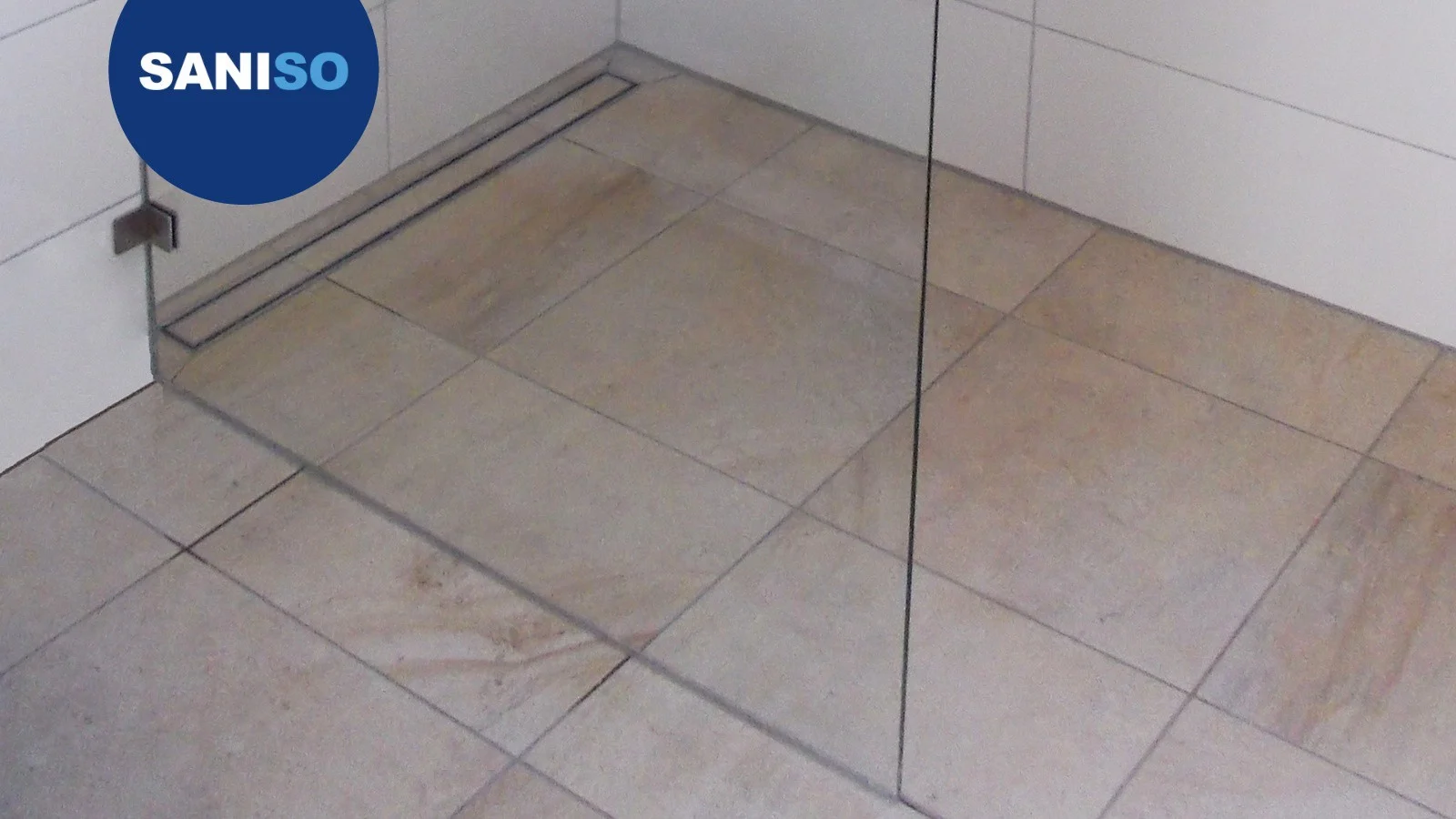
Build a level walk-in shower with Progress Profiles Proshower: slope, waterproofing, drain and edge profiles as one buil...

Your online building supplies store for building and renovation
 English
✓
English
✓
 Nederlands
✓
Nederlands
✓
Why this brand · Progress Profiles #2 · The brands Saniso stocks, and why
Long before the first tile goes down, a building site needs parts that disappear into the concrete: spacers that hold the reinforcement in place, chamfer strips that shape the edges and waterstops that close the joints. In this second Progress Profiles edition of our series Why this brand we look at concrete spacers and the other site products the brand makes for formwork and concrete work. For the brand overview, start with Progress Profiles tile profiles and installation systems; for the brand's shower system, read building a level walk-in shower with Progress Profiles.
In short
Concrete spacers: keep reinforcement bars and mesh at the planned distance from the formwork, so the concrete cover is right.
Formwork: Prodistanz spacers for placing and securing shuttering panels.
Chamfer strips: PVC strips in the formwork corners give walls and columns a bevelled edge.
Waterstops: PVC profiles cast into the concrete across a joint for a watertight seal.
At Saniso today: these Progress Profiles items are sold on quotation: click "Request Quote" on the product page.
Reinforced concrete works as designed when the steel sits where the structural engineer drew it. Spacers keep that distance during the pour, so the reinforcement ends up fully embedded with the planned concrete cover, which protects the steel against corrosion and fire. Chamfer strips shape the edges of walls and columns while the concrete is still in the formwork, and waterstops seal the joints between two pours where water could otherwise find a way through. All three are small parts that are hard to correct once the concrete has set, so it pays to choose them before the pour. For how reinforced concrete came about, see the history of concrete.
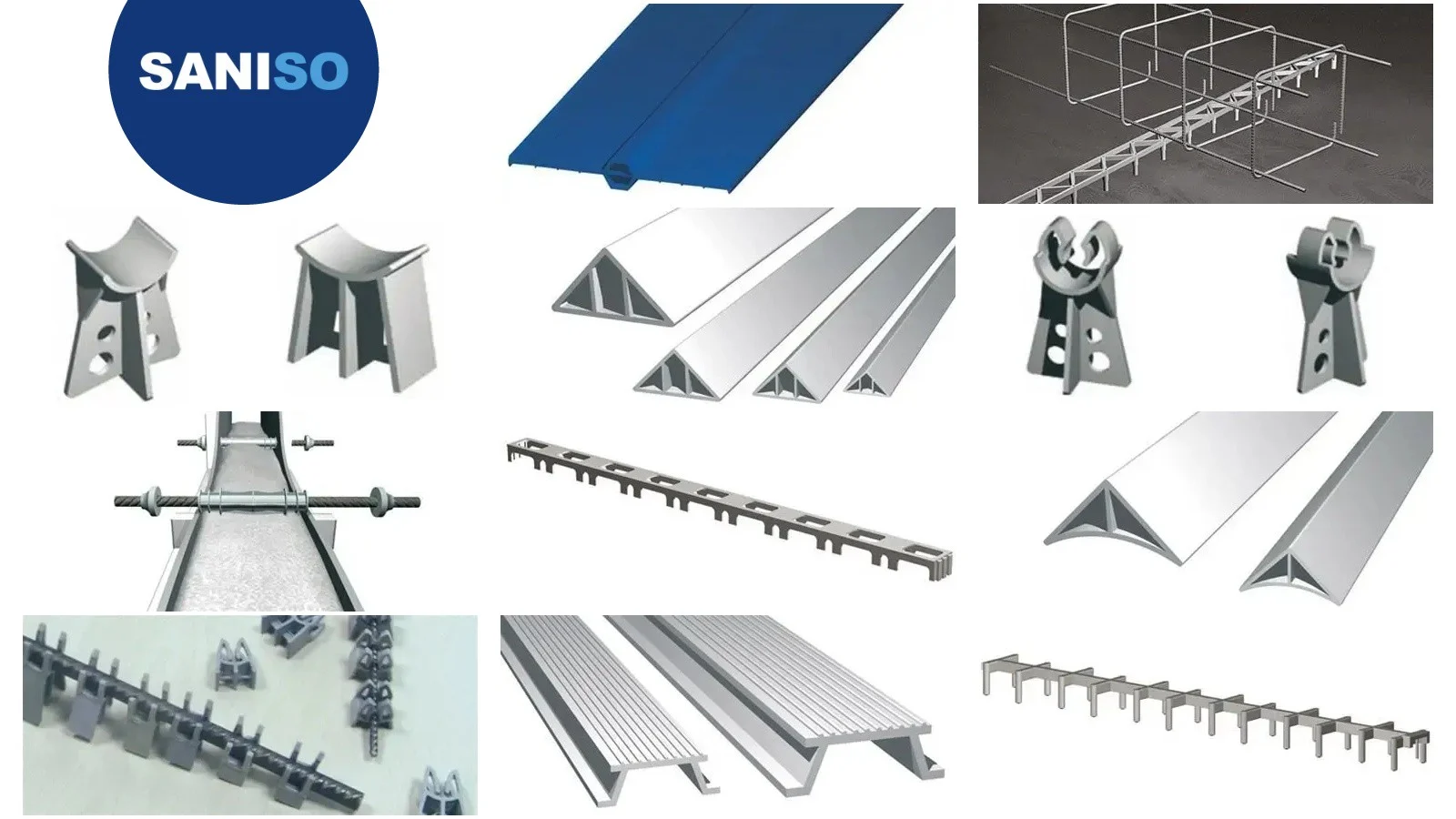
Next to tile profiles and shower systems, Progress Profiles makes a line of site products in grey HD polyethylene and rigid PVC. On saniso.nl you can open, among others, the linear spacers Rapy 100 and Rapy 200, single spacers such as PAS spacers, PAX spacers, PAU spacers and PAL spacers, the multi-foot spacers, the Prodistanz spacers, the triangular chamfer strip, the drip course profile and the Waterstop profile. The table sums up what each product page says.
| Product | What it does (product page) | Sizes listed |
|---|---|---|
| Rapy 100 | Linear spacer for heavy loads; holes in the top and sides let the concrete penetrate | 1 m bars, PLF 20 to PLF 60 |
| Rapy 200 | Linear spacer for horizontal, vertical and sloping concrete structures | 2 m bars, PLF 20R to PLF 40R |
| PAS spacers | For heavy reinforcement and large-diameter rods, up to Ø 28 mm | Formwork distance 15 to 50 mm |
| PAX spacers | For horizontal mesh, Ø 10/16 mm | Formwork distance 15 to 40 mm |
| PAU spacers | Universal spacer, horizontal and vertical, for the crossing points of welded mesh | Formwork distance 10 to 40 mm |
| PAL spacers | Lightweight spacer to join up mesh in floor slabs at the right distance from the formwork | PPO 15, PPO 20, PPO 25 |
| Prodistanz spacers | Placing and securing shuttering panels without cutting tie-rods or fitting washer plates on site | 15 to 40 cm |
| Triangular chamfer strip | Forms a chamfer on the edges of concrete walls and columns; rigid grey PVC | 2 m bars, PST 10 to PST 30 |
| Waterstop profile | Plasticised PVC for a watertight seal, even under pressure; flat and with bulb | Rolls of 25 m, WP 100 to WP 300, WB 200 to WB 300 |
We wrote this SWOT for the person preparing a pour: what the Progress Profiles site range does well, where it opens doors, where it fits best and why we carry it.
Strengths
Opportunities
Where Progress Profiles fits best on the building site
Why Saniso carries Progress Profiles
Start from the drawing: the structural engineer or the specification gives the concrete cover and the bar or mesh diameter. Then choose the type. Linear spacers such as Rapy 100 give long, even support under bars and mesh. PAS spacers are made for heavy reinforcement and large rods, PAX spacers for horizontal mesh, PAU spacers for the crossing points of welded mesh, horizontal or vertical, PAL spacers to join up mesh in floor slabs and Doppy spacers for mesh up to Ø 8 mm. For PAS, PAX and PAU the product page lists the formwork distance in mm per article, so you can match the spacer to the required cover.
Place the spacers before the pour: under the bottom reinforcement and against the side formwork, at the spacing the engineer or the spacer maker gives. They carry the reinforcement and the people who walk on it during the pour, so use a type that is made for that load. Check that every bar and mesh rests on a spacer and that no steel touches the formwork. Look again just before the concrete arrives: mesh that has been trodden down loses its cover.
According to the product page, the patented Prodistanz spacers simplify, improve and speed up placing and securing shuttering panels for concrete, so you avoid cutting tie-rods and assembling washer plates on site. They come in sizes from 15 to 40 cm and with two plug types: a hollow plug for walls that will be plastered and a smooth plug for walls without plaster. Choose the size and the plug that match your wall, and ask us if you are unsure.
A chamfer strip sits in the inside corner of the formwork and gives the concrete edge a bevel instead of a sharp corner. A bevelled edge is less likely to chip when the formwork comes off and in daily use, and it looks neater on walls and columns that stay visible. The Progress Profiles triangular chamfer strip is made of rigid grey PVC, comes in several widths (PST 10 to PST 30, 2 m bars) and is described as tough and easy to lay. There is also a rounded triangular chamfer strip. Fix the strips straight and tight, so no concrete runs behind them.
A waterstop is cast into the concrete across a joint, half in the first pour and half in the next, so water cannot follow the joint through the structure. Typical places are basement walls and floors, pits and tanks, where the concrete has to hold back water. The Progress Profiles Waterstop profile is made of blue plasticised PVC with good mechanical strength, elasticity and ageing resistance, for a watertight seal even under pressure. You can choose flat waterstops (WP 100 to WP 300) and waterstops with a bulb (WB 200 to WB 300), on rolls of 25 m; anchoring clips are available on request. The structural engineer decides which type and width each joint needs.
A drip course profile is cast into the underside of a concrete overhang, such as a balcony slab, a canopy or a window sill, to form a drip groove. Rainwater then drips off at the groove instead of running along the underside back to the wall. The Progress Profiles drip course profile is made of rigid grey PVC in 2 m bars (GCT 20 and GCT 30).
Open the Progress Profiles brand page for the full range. The concrete spacers, chamfer strips and waterstops in this article are sold on quotation: open the product page, click "Request Quote" and give the article codes and quantities you need, or collect everything on your Project List first. Prices on saniso.nl and at checkout include VAT; your quotation shows the price.
Order on a workday before 15:00? Then your order is delivered the next workday, as long as it fits in a parcel. Pallet shipments have a different delivery time. Saniso has thousands of products in stock in the Netherlands. Saniso is on its way to becoming the e-commerce platform for construction across Europe, and already delivers to more than 20 countries.
Your first order is easy to place:
Want to know when there are new offers? Sign up for the newsletter: scroll to the bottom of any page on saniso.nl, enter your email address under "Newsletter" and click "Subscribe". You'll get updates on offers and discount coupons, and we don't spam. With an account you also collect loyalty points for a discount on your next purchase.
More about this in the Saniso FAQ under "How do I sign up for the newsletter?". Questions about ordering, payment, shipping or returns are answered there too.
What are concrete spacers?
Supports that hold the reinforcement at the planned distance from the formwork during the pour, so the concrete cover is right. The Progress Profiles spacers on saniso.nl are made of grey HD polyethylene.
What is concrete cover?
The layer of concrete between the reinforcement and the outside surface. It protects the steel against corrosion and fire; the required thickness comes from the structural design.
Which spacer do I use for mesh?
According to the product pages: PAX for horizontal mesh (Ø 10/16 mm), PAU for the crossing points of welded mesh, PAL to join up mesh in floor slabs and Doppy for mesh up to Ø 8 mm.
Which spacer suits heavy reinforcement?
PAS spacers are designed for heavy reinforcement and large-diameter rods. Rapy 100 linear spacers and multi-foot spacers are also made for heavy loads.
What is the difference between Rapy 100 and Rapy 200?
Rapy 100 comes in 1 m bars (PLF 20 to PLF 60). Rapy 200 comes in 2 m bars (PLF 20R to PLF 40R) and is described as ideal for horizontal, vertical and sloping structures.
What does a chamfer strip do?
It sits in the corner of the formwork and gives concrete walls and columns a bevelled edge, which looks neat and is less likely to chip.
What is a waterstop?
A PVC profile that is cast into the concrete across a joint, so water cannot pass through the joint.
Do I need a flat waterstop or one with a bulb?
Both types are available (WP and WB). The structural engineer or the specification decides which type and width each joint needs.
What are Prodistanz spacers for?
For placing and securing shuttering panels without cutting tie-rods or assembling washer plates on site. Sizes run from 15 to 40 cm.
How do I get a price for these Progress Profiles products?
They are sold on quotation: click "Request Quote" on the product page or add them to your Project List, with the article codes and quantities you need.
Do the prices include VAT?
Prices on saniso.nl and at checkout include VAT. For Progress Profiles items on quotation, the price is on your quotation.
What is the delivery time at Saniso?
Order on a workday before 15:00 and it's delivered the next workday, as long as it fits in a parcel. Pallet shipments have a different delivery time.
Can I pick up my order?
Yes, you can pick up your order for free in our showroom.
Header images: Progress Profiles product images from the product pages on saniso.nl (Waterstop profile, Rapy 100, PAS, triangular chamfer strip, PAX, Prodistanz, Rapy 200, rounded triangular chamfer strip, PAU, drip course profile, multi-foot spacers), shown at original size.
Next in Why this brand: more of the brands Saniso stocks, and why.
Share:
Build a level walk-in shower with Progress Profiles Proshower: slope, waterproofing, drain and edge profiles as one buil...
Why Cersanit sanitaryware at Saniso: ceramic washbasins, ZEN bathroom furniture and ZEN shower sets that work as one bat...
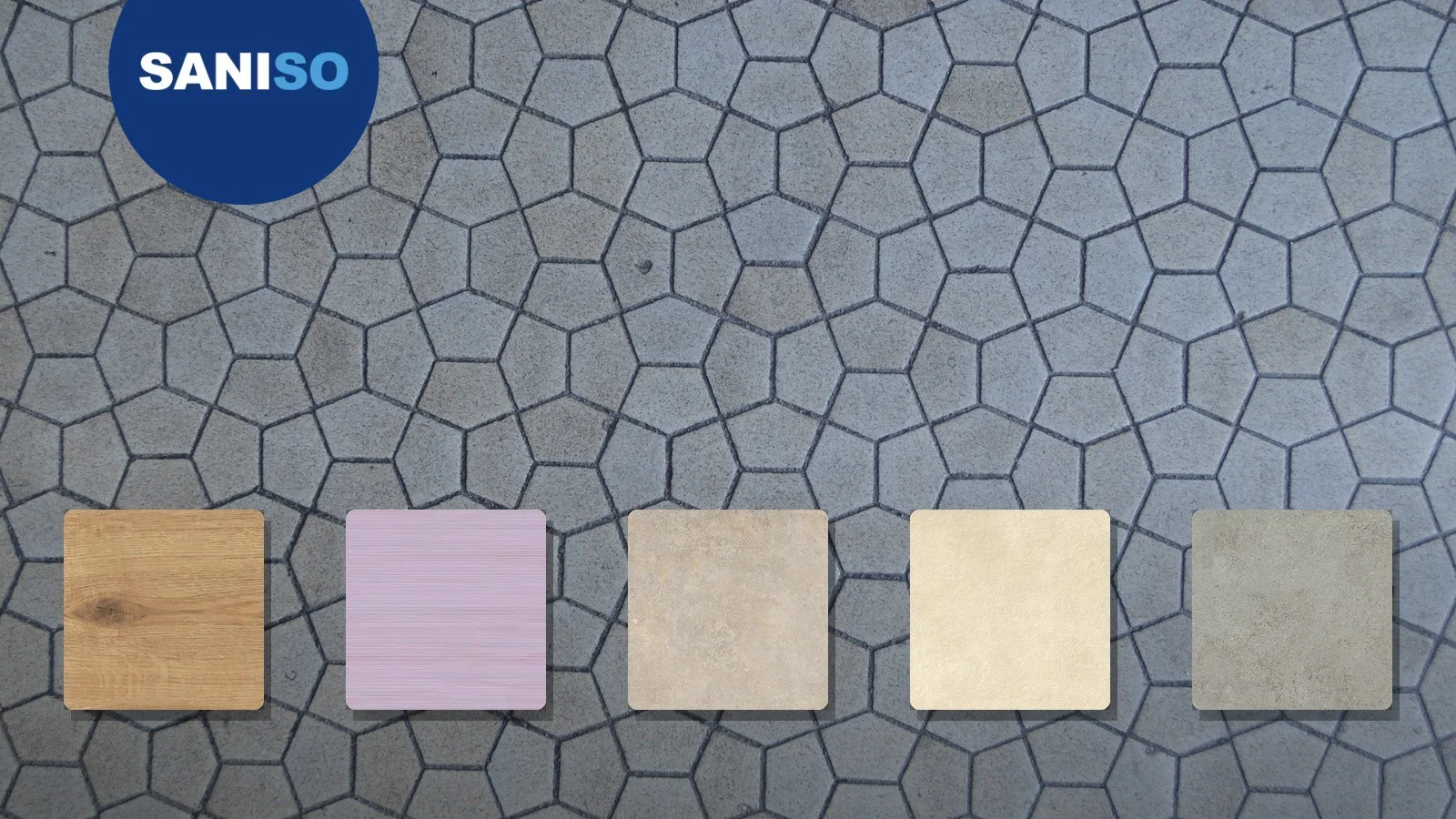
Why Cersanit tiles at Saniso: wood, floral, stone, monocolour and outdoor collections for walls and floors, with 5 price...
Laying large-format tiles with Kerakoll: H40 Gel up to 3000 × 1500 mm, coverage per mm, Biogel for deformable substrates...