Your online building supplies store for building and renovation

0 Your Cart 0.00€

Cart (0)

No products in the cart.

How do you transport sanitaryware and furniture safely? Washbasin, toilet, bath and bathroom cabinet

How do you transport sanitaryware and furniture safely? Washbasin, toilet, bath and bathroom cabinet

A new toilet, a washbasin cabinet or a bath: sanitaryware and bathroom furniture are fragile, heavy and awkward in shape. Ceramic cracks at the first knock, a mirror cabinet contains glass, and a cabinet with drawers is easily damaged if lifted the wrong way. With good packing, a smart transport plan and the right aids, you get sanitaryware and furniture home safely. This blog explains how, and when to leave it to a carrier or professional. Installing sanitaryware itself is covered in our guide to planning a bathroom renovation.

👷 Calling in a professional or carrier is never superfluous. A steel or cast iron bath, a large bathroom cabinet with a stone top or a walk-in shower with glass is heavy and fragile. A carrier has the experience, the lifting aids and the insurance. For connecting and fitting sanitaryware, a certified installer or professional is also recommended, especially for water and drainage.

Which sanitaryware and furniture are you transporting?

Treat everything that can break as fragile. Is the weight unknown or more than about 25 kilos? Then do not lift alone, and read our blog on lifting heavy materials safely.
Preparing: plan your transport

  1. Measure. Does it fit in your car or trailer, through the door and up the stairwell? Measure the package and the route.
  2. Buy or collect it in the original packaging. The factory packaging protects best. Keep cardboard corners and foam edges when unpacking.
  3. Decide on the route. Walk the route without a load: thresholds, stairs, corners and narrow hallways.
  4. Bring a second person. For a large cabinet, bath or mirror cabinet you do not lift alone.
  5. Take everything loose out. Remove drawers, shelves and loose doors from the furniture and pack them separately. It gets lighter and stays intact.

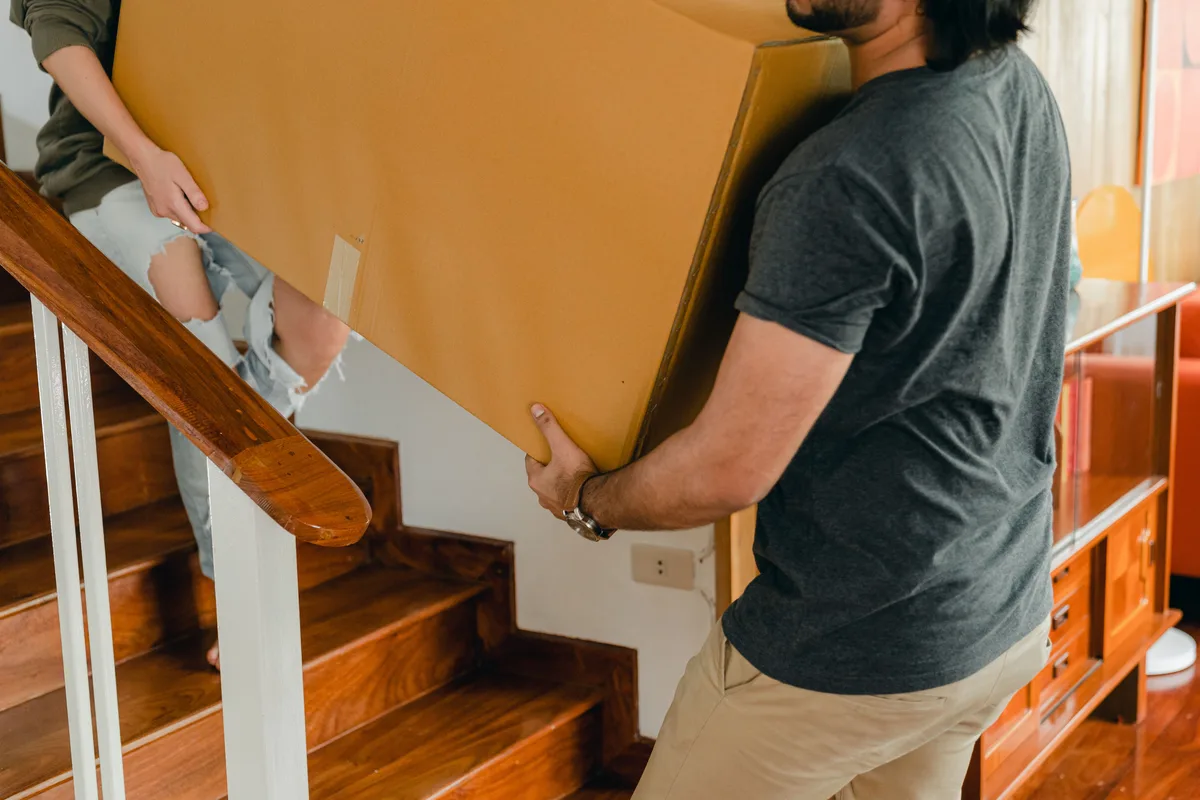
Two people carrying a large cardboard box together along a staircase in a home

Packing: how to protect sanitaryware and furniture

  • Ceramics: wrap a toilet or washbasin in bubble wrap or a blanket and place it in the original box. Never put anything heavy on ceramics.
  • Glass and mirrors: stand a mirror cabinet upright and pack glass parts separately. Do not stick tape directly on glass or a high-gloss front; use a self-adhesive protective film that leaves no residue, and always test it on a small spot first.
  • Furniture: cover a bathroom cabinet with a blanket or film. Keep drawers closed with transparent stretch film or take them out. Use cardboard corner protectors.
  • Baths and shower trays: transport them in the original packaging, lying on a flat surface with soft layers in between, and never on their edge.
  • Closing the package: use brown packing tape to close boxes. Write "fragile" and "this way up" on the outside so you and others know how to handle it.

💡 Pack small parts such as taps and traps in their own box and keep it with you in the front, not between the sanitaryware. That way everything is together when you fit it.

Lifting and carrying

  • Close to your body, straight back, bent knees. That is the basis, even with a light box. See also our blog on lifting heavy materials safely.
  • Lift together with clear agreements: who walks in front, who counts down, when to put down.
  • Use a cart. A workshop trolley with three shelves moves boxes and a bathroom cabinet over a flat floor so you do not have to lift. Secure the load properly.
  • Stairs are the most dangerous part. Narrow or steep stairs, or a heavy or fragile package? That is a job for a carrier.
  • Keep your view clear. Never carry a package so that you cannot see your feet.

Securing in a car or trailer

  1. Put heavy sanitaryware or furniture low and against the direction of travel, with the heaviest side forward.
  2. Use anti-slip mats or blankets to prevent sliding, and put soft layers between the items.
  3. Secure the load with a strap with double hook or set of straps with double hook. Tighten firmly, but not so tight that you crush ceramics or a cabinet panel.
  4. Make sure nothing can slide onto or fall onto the sanitaryware.
  5. Drive calmly: pull away smoothly, brake early and take corners slowly.
  6. Respect the maximum load and the overhang of your vehicle. In doubt, have it delivered or moved by a carrier.

You can read more about securing loads in our blog on load securing for professionals.

Personal protective equipment (PPE)

You can read more about safe working in our blog on safe working on the construction site.

⚠️ Is there a crack or break in ceramic or glass? Do not use it any more, because a break can suddenly get bigger in use. Clear up pieces with gloves and glasses.

When do you call a professional or carrier?

  • For a steel or cast iron bath, a large cabinet with a stone top or a walk-in shower with glass.
  • For stairs, narrow spaces, or if the package must go above shoulder height.
  • If you do not have a second person, a cart or a suitable vehicle.
  • If the weight is unknown or about 25 kilos or more.
  • For connecting water and drainage: leave that to a certified installer.

A professional is never superfluous. That is not weakness, but craftsmanship.

Checklist for transporting sanitaryware and furniture

  • Weight, dimensions and route checked.
  • Original packaging and protective material available.
  • Drawers, shelves and loose parts removed from the furniture.
  • Gloves, safety shoes and glasses on.
  • Lift together or use a cart.
  • Load secured with straps and nothing loose.
  • Taps and parts in their own box.

Frequently asked questions

How do I transport a toilet or washbasin without damage?

Pack it in the original box with bubble wrap or a blanket, secure it stably in your car, and never put anything heavy on top. Lift calmly, preferably with two people.

Can I transport a bathroom cabinet lying down?

That depends on the furniture. Follow the manufacturer's instructions. Usually you transport it in the original box, with the drawers out and a soft layer between the parts.

Should I collect a bath myself?

A bath is large, slippery and sometimes very heavy. A carrier does this more safely. If you still want to do it yourself, you need a second person, suitable lifting aids and a suitable vehicle.

Why no tape on glass or high gloss?

Tape leaves adhesive residue and can damage the finish. Use soft protective film, a blanket and straps that do not pull directly on the finish.

Read also: How to transport tiles and slabs safely and How to transport ladders and scaffolding safely

Read also: How to transport timber and long materials: roof rack and securing

Where can you find everything for this job?

At Saniso, the online store for DIYers and professionals, you will find tools, materials and personal protective equipment for your job.

In doubt about the approach? Feel free to call in a professional.

Saniso – Build your home with Saniso.

« Previous
Next »
Saniso Support Online +31 85 488 5920

Hi there! How can we help you today?