





Comparing LED bathroom mirrors before you buy? See how the Saniso+ mirror stacks up on dimming, sizing, and water resist...

Your online building supplies store for building and renovation
 English
✓
English
✓
 Nederlands
✓
Nederlands
✓
Recessed spotlights bring calm and atmosphere to a bathroom, but too few spots leave the room dim and too many give a hard, busy ceiling. How many spots you need depends on the size of the bathroom, the colour of the walls and what you do in the room. In this blog we give you a calculation guide to plan the number of spots. The electrical side, so fitting and connecting, is always for a certified electrician.
👷 This is a planning blog, not an installation guide. Bathrooms have strict electrical rules: there are zones, each with its own minimum IP rating, and the transformer or driver must be in the right place. Fitting and connecting recessed spotlights is work for a certified electrician. Calling in a professional is never unnecessary: they know the rules, assess your ceiling and make sure everything works safely.
Light is measured in lumens (lm), not watts. Watts only tell you how much power a lamp uses. As a rule of thumb for general lighting in a bathroom, count on roughly 300 to 400 lumens per m². With light tiles you are at the lower end of that range. With dark walls or matt natural stone you need more light, because dark surfaces absorb a lot of it.
The calculation guide has three steps:
💡 Draw a floor plan on paper with a carpenter pencil and sketch the spots on it. You immediately see whether the layout works before you show the plan to your electrician.
The numbers below are worked examples with spots of about 400 lumens. An electrician adjusts them to your ceiling, your walls and the position of the mirror.
Want a little more headroom? Choose a dimmable spot. Then you can set the light brighter during the day and softer in the evening.
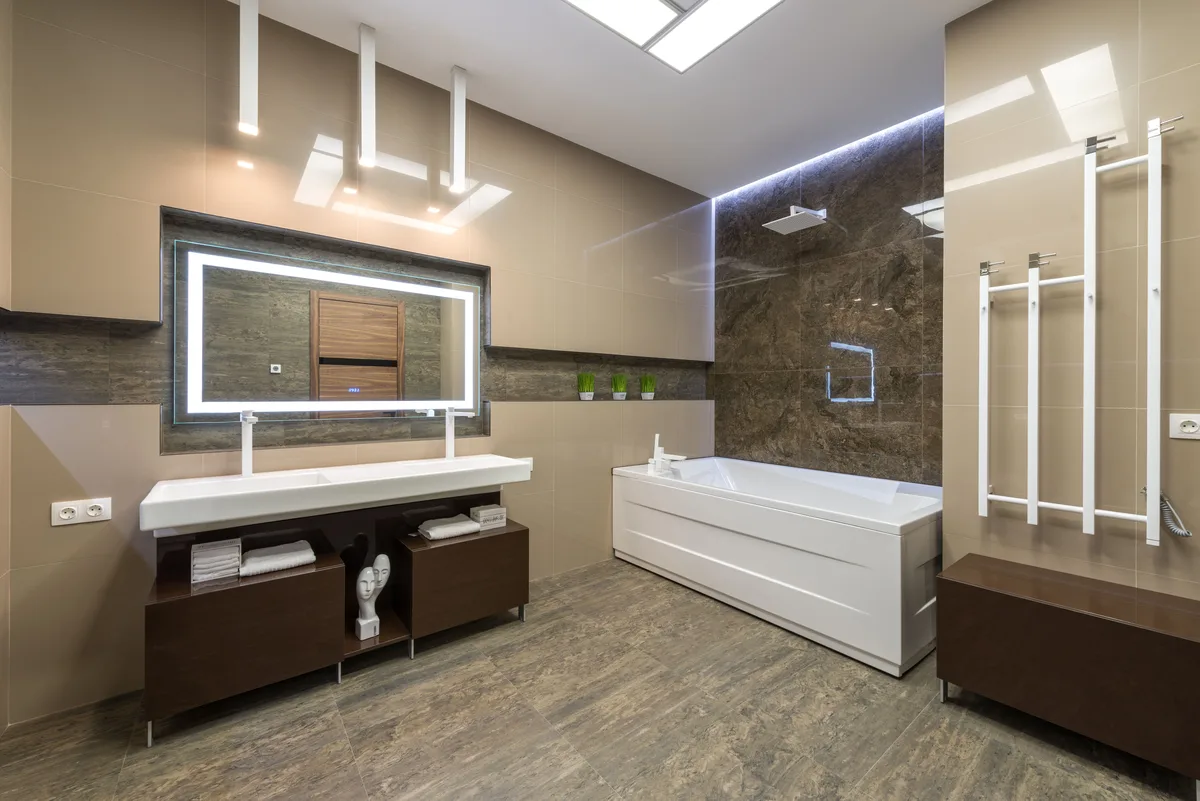
A good layout matters as much as the number. A few guidelines for your plan:
⚠️ Whether a spot is allowed in a particular place in a bathroom depends on the zone and the IP rating. Always plan your ceiling together with a certified electrician and let them decide the final positions.
💡 Do not mix too many colour temperatures in one room, except deliberately at the mirror. Choose one warm-white base and a neutral white accent at the basin.
Ceiling spots provide the basic lighting, but at the basin they easily cast shadows under the chin and eyes. That is why extra mirror lighting is a good choice. An LED mirror with lighting or wide LED mirror has lighting in the mirror itself, and a mirror cabinet or mirror cabinet in white adds storage, with the light above the basin planned separately. How to hang the mirror itself is covered in our blog on hanging a bathroom mirror. The electrical connection of a lit mirror is also left to the electrician.
We explain this only so you can have a good conversation with your electrician. They make the choices.
Light is part of the whole design: tiles, vanity unit, mirror and shower. In our blog on the Saniso bathroom configurator you can read how to lay out your bathroom, and in our blog on tiling a wall you can see how tiles are fitted on the wall to reflect the light later. Glossy tiles and a glass Larga shower enclosure with tray reflect light, matt dark walls absorb it. Take that into account when deciding the number of spots.
This is a planning blog and you do not carry out any installation steps yourself. If you do get your hands dirty in the preparation, for example when clearing the bathroom before the electrician arrives, wear work gloves with nitrile coating and safety goggles. Never work on the electrical installation yourself.
As a guideline you use about 350 lumens per m². That is around 1,400 lumens. With spots of 400 lumens that comes to 4 spots. Your electrician adjusts this to your ceiling and walls.
Warm white (2700 to 3000 kelvin) for a cosy atmosphere. At the mirror, neutral white of around 4000 kelvin is pleasant for a clear view.
The colour rendering index shows how natural colours look under the light. A value of 90 or higher gives accurate colour rendering.
They do not have to be, but it is pleasant. Dimmable spots let you adjust the light to the time of day. Ask your electrician for a combination of spot, driver and dimmer that works well together.
No. Electrics in a bathroom are work for a certified electrician, because of the zones, the IP rating and the transformer. Calling in a professional is never unnecessary.
At Saniso, the online store for DIYers and professionals, you will find tools, materials and personal protective equipment for your job.
In doubt about the approach? Feel free to call in a professional.
Saniso – Build your home with Saniso.
Share:
Comparing LED bathroom mirrors before you buy? See how the Saniso+ mirror stacks up on dimming, sizing, and water resist...

Grout in one even colour across the whole wall or floor: that is what you want. In this blog we explain how the hybrid R...

Learn how to level a floor yourself: prepare the subfloor, prime, mix and pour self-levelling compound. Step-by-step wit...

Installing a kitchen: do it yourself or hire a professional? Read what is involved, which parts you can do yourself and...