






Grout in one even colour across the whole wall or floor: that is what you want. In this blog we explain how the hybrid R...

Your online building supplies store for building and renovation
 English
✓
English
✓
 Nederlands
✓
Nederlands
✓
A green lawn and full borders need a lot of water in dry periods. Walking around with the hose or a watering can every evening takes time, and you often give too much in one place and too little in another. With simple garden irrigation you spread the water much more evenly. In this blog you will read how to install a sprinkler system yourself with a garden hose, splitters and sprinklers, and what to look out for.
👷 Calling in a professional is never superfluous. If you want a permanent underground system with buried pipes and automatic zones, or if a new outdoor tap is needed, have it done by a landscaper or a qualified plumber. Work on the water supply in your home is not a DIY job.
There are roughly three ways to water your garden automatically or semi-automatically:
Read more about the right garden tools in our guide to Stalco Garden tools.
Draw your garden on a sheet of paper and measure it. Mark where the lawn is, where the borders and vegetable patch are and where the outdoor tap is. Then divide the garden into zones that need roughly the same amount of water:
💡 When planning, also look at the wind and the sun. In a windy spot, the water from a sprinkler is easily blown away, and watering in the full midday sun mostly evaporates.
How many sprinklers you can use at the same time depends on the water pressure and the amount of water coming from your tap. Test it simply: put a ten-litre bucket under the tap and see how quickly it fills. If it is slow, use only one sprinkler per zone at a time.
⚠️ Do you not have an outdoor tap yet, or does the current one leak? Have a new tap connected by a qualified plumber. An outdoor tap needs a proper vacuum breaker or non-return valve and a way to drain it for winter, so that garden water cannot flow back into the drinking water supply and the pipe does not freeze.
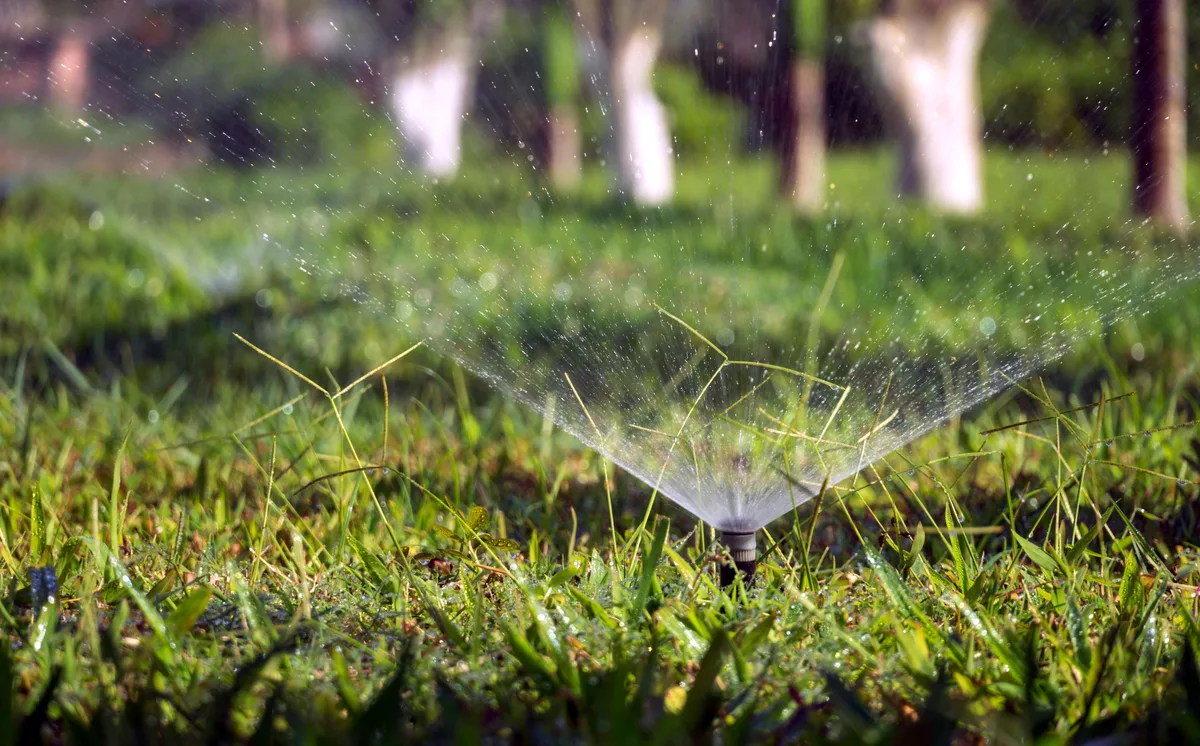
Place the sprinklers so that their reach overlaps slightly. That way the edge of each circle also gets enough water. Put the sprinkler on a firm, level spot or push the spike firmly into the ground. Then slowly open the tap and adjust the spray:
Wear gloves when digging and use a kneeling pad when you work on the ground for a long time. Lay hoses so nobody can trip over them and wind them onto the reel after use. If you dig a trench, check beforehand whether there are cables or pipes in the ground. If in doubt, or if something needs to be done to the water supply or the outdoor lighting, call in a qualified installer. Read more about the right gloves for the garden in our blog on gardening gloves and tools.
Turn off the tap and let the hoses and sprinklers drain. Disconnect the connectors and store everything frost-free. Have the outdoor tap drained for winter according to your plumber's instructions.
That depends on the water pressure. With an average tap, one or two sprinklers at a time work well. With more sprinklers, use a splitter with valves and water the zones in turn.
You can hide an ordinary garden hose in a shallow trench along the edge. A permanent underground system with pop-up sprinklers needs special pipes and a good design; have that installed by a professional.
Yes. After a shower, first check whether the soil is still moist. Too much water is just as bad for your lawn as too little.
Work on the water supply is best left to a qualified plumber. They make sure the connection is safe, with a non-return valve and a drain tap for winter.
Read also: How to get your garden ready for winter
Read also: How to trim a hedge: step-by-step DIY guide
At Saniso, the online store for DIYers and professionals, you will find tools, materials and personal protective equipment for your job.
In doubt about the approach? Feel free to call in a professional.
Read also: How to lay a new lawn: step-by-step guide for seed and turf
Saniso – Build your home with Saniso.
Read also: Buying shut-off valves and ball valves: what to look for
Share:
Grout in one even colour across the whole wall or floor: that is what you want. In this blog we explain how the hybrid R...

Learn how to level a floor yourself: prepare the subfloor, prime, mix and pour self-levelling compound. Step-by-step wit...

Installing a kitchen: do it yourself or hire a professional? Read what is involved, which parts you can do yourself and...

Cersanit Ares cement-look tiles for bathroom, kitchen and living room: 30×30 to 60×120, matt or satin, plus mosaic, skir...