Grout in one even colour across the whole wall or floor: that is what you want. In this blog we explain how the hybrid R...

How to clean while tiling
A tiling job is only finished once it is clean. Adhesive on the tile surface, grout in the wrong places and a grey haze over the whole floor all come with tiling, but they become hard and stubborn if you leave them. If you wipe in time, change your buckets often and tackle the final clean properly, you keep tiles, joints and tools in top condition. In this blog you will read how to clean during and straight after tiling: from cement haze, adhesive residue and grout residue to epoxy grout residue, and how to protect the finished work afterwards. We mention products from Fila, which you will find at Saniso.
Note: cement-based adhesive and grout are caustic and cleaners are chemical. Wear gloves, safety glasses and knee pads, and always read the product information on the packaging. If in doubt, with natural stone and with expensive tiles, call in a professional: a professional is never superfluous.
Why is cleaning in time so important?
Adhesive and grout that are still wet wipe off easily with a damp sponge. Once they set, the cement bonds to the tile surface and into the pores. That leaves a white or grey haze (cement haze) that you can only remove with a special cleaner. The difference between the same job with and without timely wiping is hours of work, and sometimes tiles that stay permanently dull or blotchy.
| Soiling | When to tackle it | Approach | Aid |
|---|---|---|---|
| Fresh adhesive on the tile or in the joint | Immediately, while the adhesive is still wet | Wipe off with a damp sponge or cloth; do not let water run into the adhesive bed | sponge and microfibre cloth |
| Grout on the tile surface | Once the grout has firmed up and no longer smears | Wipe diagonally with a lightly damp sponge; rinse the sponge often | grouting float, sponge, clean buckets |
| Cement haze (film after hardening) | At the final clean, once the grout has cured enough (see packaging) | Cement haze remover: wet first, leave to work, brush, rinse thoroughly | Fila Deterdek Pro |
| Epoxy grout residue | As soon as possible, following the epoxy grout instructions | Wipe off fresh residue first; use a dedicated epoxy cleaner on dried residue | Fila CR10 |
| Dirty joints after the job | At the final clean | Grout cleaner, leave to work, brush | Fila Fuganet |
What do you need?
What materials and cleaners do you need?
- A cement haze remover for the final clean: Fila Deterdek Pro. This is a buffered acid cleaner designed for cleaning wall and floor tiles after installation.
- For epoxy grout residue: Fila CR10, a cleaner for non-absorbent surfaces such as porcelain tiles and glazed ceramic.
- For cleaning the joints: Fila Fuganet.
- For protecting cement-based joints after cleaning: Fila Fuga Proof.
- For everyday floor care afterwards: Fila Cleaner Pro. For heavily soiled floors or the first clean of natural stone that is not acid-resistant: Fila PS87 Pro.
- Want everything in one package? The Fila Starter Kit contains Deterdek Pro, Cleaner Pro, a sponge, a microfibre cloth and gloves, intended for thoroughly cleaning new tiling.
- See the whole range on the Fila brand page, and our maintenance and cleaning chemicals category.
What tools do you need?
- A sponge and a microfibre cloth for wiping and drying.
- Two or more buckets: a 16 litre bucket for clean water and a second for rinse water. For the final clean a large 40 litre construction bucket also works.
- A hand brush and a scouring sponge (not on sensitive tiles) to work in the cleaner.
- A grouting float for applying and finishing the grout
What personal protection is required?
- Rubber or chemical-resistant gloves or nitrile gloves for working with cleaners and wet cement. Read the product information to see which type suits your cleaner.
- Safety glasses against splashes of cleaner and cement water.
- Knee pads for working on the floor, so you do not kneel in wet mortar or cleaner.
- An FFP2 dust mask if dust is created, for example when scraping or sanding dried residue.
- You can find more protection in our workwear and safety category.
How do you clean while tiling?
- Wipe off adhesive straight away. Got adhesive on the tile surface or the joint edge? Wipe it off immediately with a damp sponge or cloth. Do not move a tile you have just laid, and do not press the adhesive further into the joint as you wipe.
- Keep the joints empty. Adhesive in the joint comes back later as a dark spot. Remove excess adhesive from the joints before it sets, and let the adhesive cure as described on the packaging before you start grouting.
- Change the buckets often. Use at least two buckets: one for clean water and one for rinsing the sponge. Replace the water as soon as it turns cloudy: grey water smears a thin layer of cement over the tile, which later returns as haze.
- Wring the sponge out well. A dripping sponge washes the grout out of the joints and causes colour differences. The sponge should be damp, not wet.
- Grout in small areas. Apply the grout with the grouting float and wipe off straight afterwards. Work in sections of one or two square metres rather than the whole floor at once.
- Wipe diagonally. Sweep across the joints at an angle with a lightly damp sponge, so you do not pull the grout out. Rinse the sponge every few strokes.
- Dry with a clean cloth. That way a thin film of water with cement particles cannot dry and leave a haze.
- Clean your tools straight away. Rinse sponge, float and buckets before the cement hardens. Do not pour cement water down the sink or into the drain, as cement can block pipes. Follow local rules for disposing of residual water and mortar.

How do you clean epoxy grout residue?
Epoxy grout is more stubborn than cement grout and hard to remove once cured. So always follow the instructions of the epoxy grout itself on timely wiping. If a haze or layer of epoxy is left behind anyway, a dedicated epoxy cleaner such as Fila CR10 helps. According to the product information it is ready to use and intended for non-absorbent surfaces (porcelain tiles, glazed ceramic, glass mosaic); you apply it undiluted with a brush, leave it for about 30 minutes, remove stubborn residue with a scouring sponge or spatula and then rinse thoroughly.
- Do not use it on absorbent materials, wood or methacrylate.
- Always test first on a small, inconspicuous piece of tile.
- Ventilate, wear gloves and safety glasses, and never mix it with another cleaner.
How do you remove cement haze at the final clean?
Cement haze is the white or grey film left when cement has dried on the tile. A cement haze remover such as Fila Deterdek Pro removes it without attacking the tiles, provided you follow the product information. For the final clean you work roughly like this (the packaging always takes priority):
- Wait until the joints have cured enough. The waiting time is stated on the packaging of your adhesive and grout.
- Test first on a trial piece. Try the cleaner on a small, inconspicuous piece of tile and joint to see whether the tile and joint cope well.
- Wet the surface with water first. That stops the cleaner soaking too deep into the joint.
- Dilute the cleaner. According to the Deterdek Pro product information that is usually 1:5 to 1:10 with water, and 1:3 for removing cement haze. Never mix with other cleaners.
- Apply to a few square metres at a time, leave the cleaner for 2 to 3 minutes, work it in with a brush and take up the residue with a cloth or wet vacuum.
- Rinse thoroughly with clean water. Rinsing is at least as important as cleaning: cleaner residue itself leaves a haze.
- Repeat if necessary with a slightly stronger solution if stubborn dirt remains, always following the packaging.
If the joints are still dirty after the job, you can clean the joints afterwards with Fila Fuganet: spray it on the joint, leave it to work briefly and brush or scrub it away. For heavily soiled joints, the product information says to do a thorough clean first with PS87 or Deterdek Pro, diluted 1:10.
How do you work safely with cleaners?

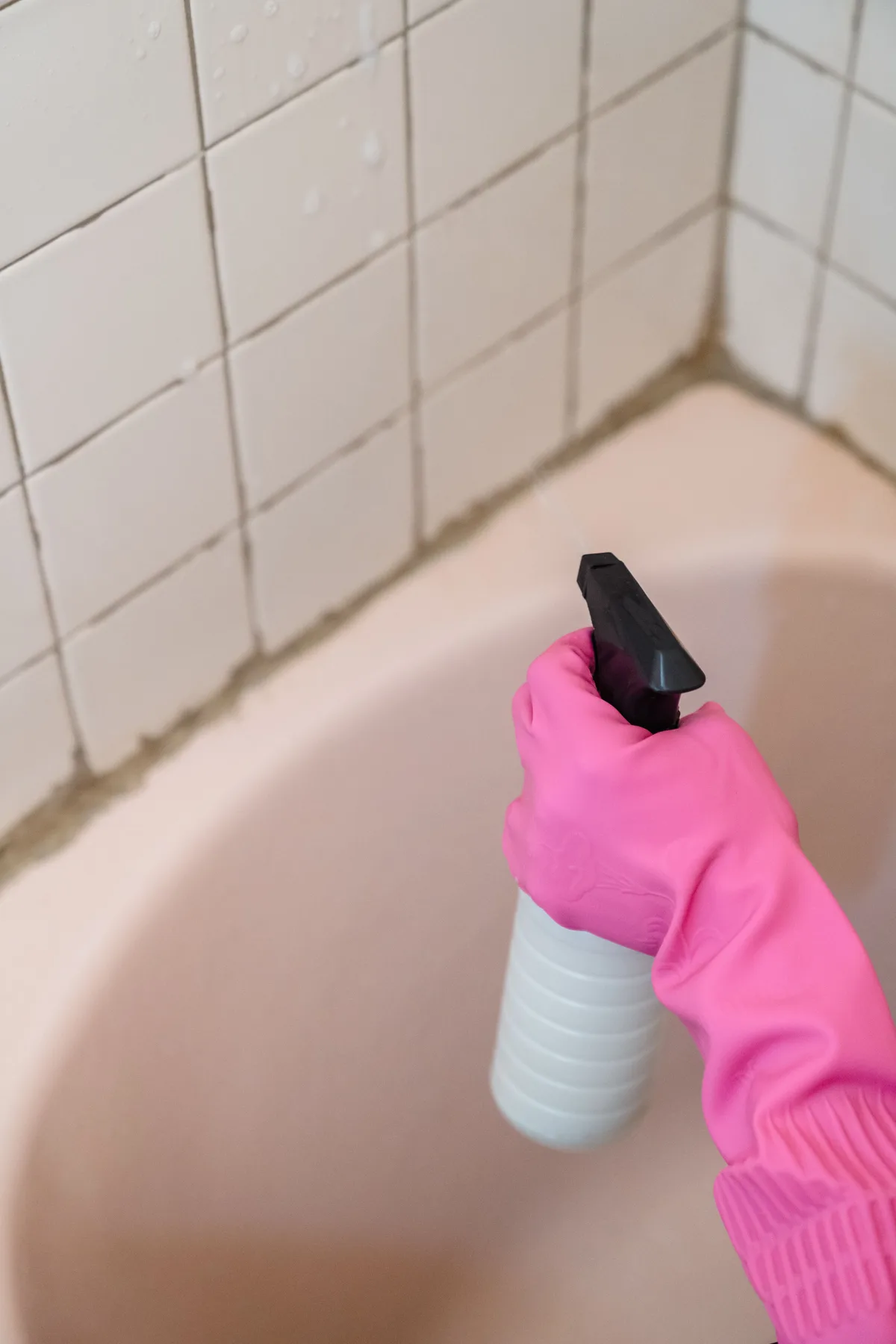
Cleaners for cement haze and epoxy are chemical. Treat them with respect, even if the packaging calls them "safer":
- Always read the product information and the safety data sheet before use.
- Ventilate well: open windows and doors, and do not work in a closed room.
- Wear gloves, safety glasses and long sleeves. Wear knee pads when working on the floor.
- Never mix different cleaners, especially acid and chlorine-based ones: that can form harmful gases.
- Test first on a trial piece in an inconspicuous place.
- If cleaner gets in your eyes, rinse for at least 15 minutes with clean water and see a doctor. For skin contact, rinse straight away with plenty of water.
- Keep cleaners away from children and pets and never leave them in unlabelled spray bottles.
You can read more general safety tips in our guide working safely on the construction site.
When do you call in a professional?
For an ordinary ceramic or porcelain tile the approach above is feasible. But tiles, joints and cleaners are a combination that is not always forgiving. Have a professional look along or do the work for:
- Natural stone and marble. Acid cleaners can permanently dull or etch natural stone. For example, Deterdek Pro must not be used on polished marble or other acid-sensitive materials, and PS87 Pro must not be used on new marble or polished stone.
- Expensive, polished or special tiles, where a mistake cannot be put right.
- Large areas, where the final clean is done with a single-disc machine.
- A haze or stain you do not recognise or that does not go after two attempts. Do not keep cleaning stronger and more often: you can damage the joint or tile.
- Epoxy grout that has already cured and covers large areas.
A professional assesses the tile, the joint and the dirt and chooses the right products. That is experience no step-by-step plan replaces. A good professional is never superfluous, even if you do most of it yourself.
How do you protect finished tiles and joints?
- Let everything dry and cure well. Follow the waiting times of adhesive, grout and cleaners before you load the floor or apply a protective layer.
- Protect the joints. Cement-based joints are porous. A joint protector such as Fila Fuga Proof makes dirt easier to remove according to the product information and stops water and stains soaking into the surface. You apply it to dry joints after cleaning with Fuganet; do not wet the treated surface for the first 24 hours.
- Cover the floor. Other work still to do, such as painting or fitting? Cover the new floor with protective cardboard or a blanket and do not drag anything heavy over the tiles.
- Everyday care. Fila Cleaner Pro is intended for everyday cleaning: a mild, concentrated cleaner for hard floors, which according to the product information is diluted in a bucket of water.
- Treat natural stone separately. Natural stone needs its own impregnation and care. Have a professional advise you.
Do you also need to seal, for example in a bathroom? Then read our blog how to reseal your bathroom with new silicone. Tiling yourself? Read how to tile a wall and how to tile a floor. Want to know how much cement you need? How many bags of sand-cement do I need? helps. And you can read about choosing the grout in Fugalite or Fugabella: which grout suits you?.
What mistakes do DIYers often make?
- Wiping too late. Once cured, cement is much harder to remove.
- Too much water. A dripping sponge washes out the joint and causes colour differences.
- Leaving dirty water. Grey rinse water smears a haze over the tile.
- Cleaner too strong or left on too long. Stick to the dilution and working time on the packaging.
- Not rinsing. Cleaner residue gives a new haze.
- No trial piece. Always test on a small piece first.
- Mixing cleaners. Never do it.
💡 Tip: build a fixed routine into every working day: at the end of the day wipe the floor once more with clean water and a cloth, and rinse your tools clean. It saves a lot of work the next day.
Where do you find everything for your job?
At Saniso, the online store for DIYers and professionals, you will find cleaners, tools and personal protective equipment for your job.
- See the Fila page, our technical and construction chemicals, our construction tools and our workwear and safety.
- Create a customer account and order easily.
- Working on a larger project or want to hand the job over? Request a project quote.
- Book a showroom visit, at least 24 hours in advance.
- Unsure about the cleaner or the approach? Contact us.
Unsure about the tiles or the dirt? Feel free to call in a professional: a good professional is never superfluous.
Saniso – Build your home with Saniso.
Share: