Cart (0)
No products in the cart.

 English ✓
 Nederlands ✓

Short answer: choose a circular saw based on what you cut. First look at the cutting depth, because that decides how thick your material may be. Then choose between corded and cordless, check the power and the guiding, and always use a saw blade that suits the material. For most jobs in and around the house, a saw of around 1200 W with a 165 mm blade is more than enough.
Read this article in Dutch as well: Cirkelzagen kopen: waar let je op?.
With a circular saw you cut quickly and straight through planks, beams and sheet material such as plywood, OSB and chipboard. You cut lengthwise (ripping) and across (cross-cutting). A circular saw is faster and straighter than a hand saw and makes longer cuts than a jigsaw. For curves, choose a jigsaw instead.
Cutting depth is the most important choice. The larger the blade, the deeper you cut.
| Blade diameter | Cutting depth at 90 degrees (approx.) | Suitable for |
| 165 mm | about 55 mm | planks, sheet material, thin beams |
| 190 mm | about 65 mm | thicker beams, scaffold boards, floorboards |
| larger | more than 65 mm | heavy carpentry and structural timber |
When you cut at 45 degrees, the cutting depth gets smaller. Always check the exact values on the product page. You can cut a beam that is thicker than your cutting depth from two sides, but the result is less neat.
A corded saw delivers constant power and has no charging time. That is handy when you cut a lot and for long periods, for example when laying a floor. The CSS165 1200 W circular saw is a good all-rounder. For thicker timber, the CSS190 1500 W circular saw with more power and a larger blade is a logical choice.
A cordless saw gives freedom on site, on scaffolding and in the garden, without an extension cable. If you already work with the Stalco 20V battery system, you use the same batteries in the CSS20 cordless circular saw. That saves on batteries and chargers. Just starting out? Then the cordless set with circular saw, jigsaw and screwdriver is handy: one battery system for sawing and screwing. An extra 20V 4Ah battery and a 20V fast charger let you keep working. Read more about the battery system in our blog on the Stalco 20V battery system.
💡 Stick to one brand and one battery system. Every battery then fits every machine and your toolbox stays organised.
Around 1200 W is enough for most jobs. More power helps with hardwood, wet timber and long cuts in thick material. A saw with too little power loses speed, burns the wood and gives a rough cut.
A straight cut starts with good guiding:
Mark out with a tape measure with auto-lock and a carpenter pencil. Read more about measuring tools in our blog on tape measures and measuring tools. Always clamp the workpiece; you can find clamps in our blog on carpenter's clamps.
The saw blade determines the quality of the cut, even more than the machine.
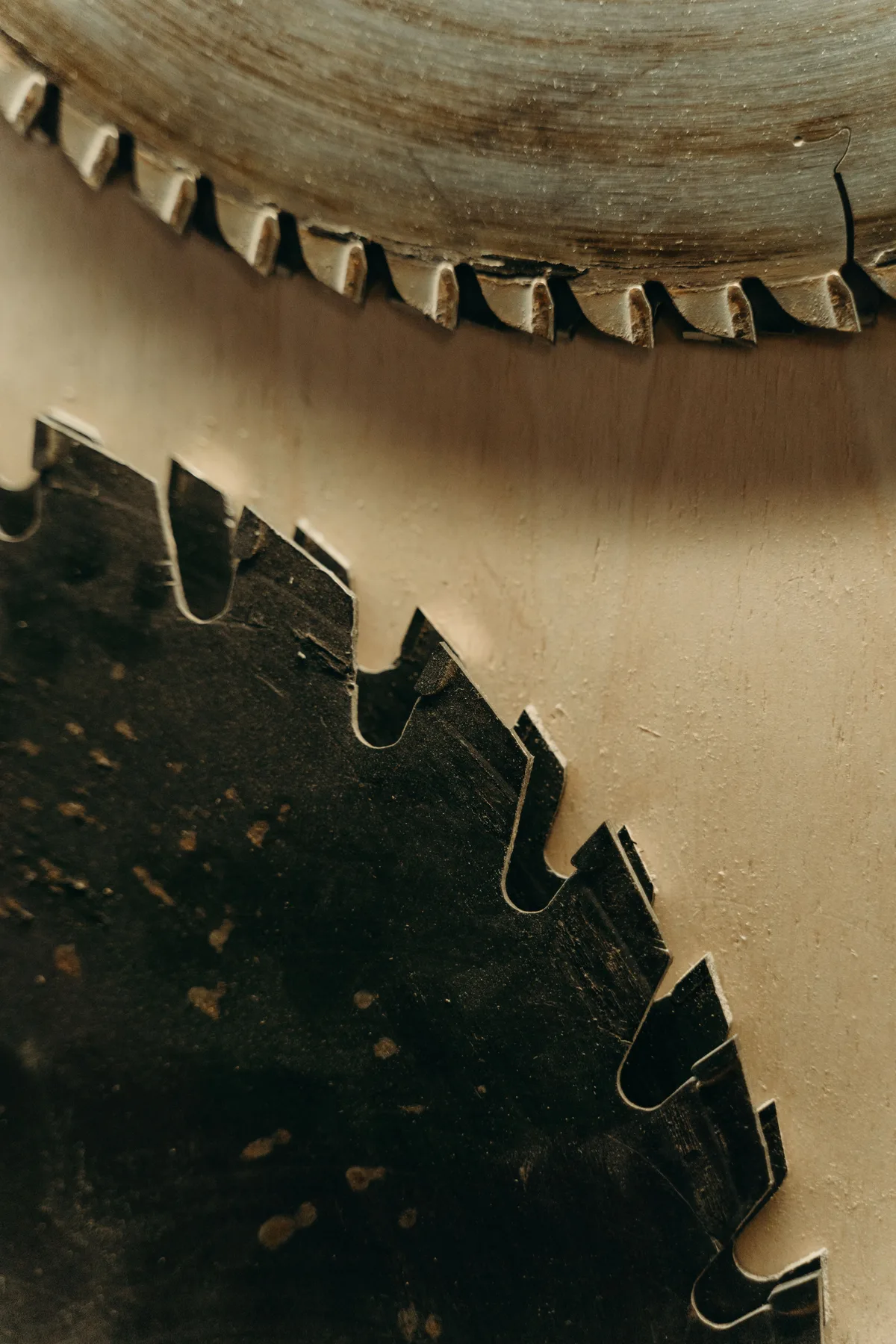
⚠️ Never use a blade with a lower permitted speed than the speed of your saw, and replace blunt or damaged blades in time.
Set the blade so that it sticks out about 5 mm below the material. You then cut cleanly, the blade gets less hot and the risk of kickback is lower. A blade that sticks out far too much is more dangerous and causes more splintering.
Kickback happens when the blade gets pinched. The saw then shoots back with force. This is how you prevent it:
Also read our blog on safety glasses for professionals and our blog on hearing protection.
Always wear safety goggles when sawing, against flying sawdust and splinters. A circular saw is loud, so use earmuffs. When cutting sheet material such as MDF or chipboard, wear an FFP2 dust mask against fine dust. Use work gloves with nitrile coating when carrying timber and sheet material, but keep loose sleeves and gloves away from the blade while sawing.
👷 A circular saw is fast and powerful. Cutting a plank to size is fine to do yourself. For structural carpentry, a complete floor or a lot of cutting at height, the experience of a carpenter or contractor is worth its weight in gold. They work faster, safer and with a tight finish.
| Situation | Advice |
| cutting a plank or sheet now and then | CSS165 1200 W circular saw |
| a lot of thicker timber and beams | CSS190 1500 W circular saw |
| working without a power point | CSS20 cordless circular saw |
| starting with a battery system | cordless set with circular saw, jigsaw and screwdriver |
| cutting steel to length | SSP355 steel cutting saw |
Not sure which saw suits you? Also read our blog on recognising quality tools and our brand blog on Stalco, or read how to organise your workspace in our blog on organising a workshop or garage.
A saw with a 165 mm blade and around 1200 W. It is light enough to steer well and strong enough for planks and sheet material.
About 5 mm. You then cut cleanly and the risk of kickback is lower.
Yes, most saws tilt up to 45 degrees. Keep in mind that the cutting depth then gets smaller.
For most jobs, yes, especially with a full 4Ah battery. For long and heavy cutting, a corded saw is often more practical.
No. Use a special blade for aluminium and a separate steel saw for steel.
At Saniso, the online store for DIYers and professionals, you will find tools, materials and personal protective equipment for your job.
In doubt about the approach? Feel free to call in a professional.
Saniso – Build your home with Saniso.
Share:
Install multilayer pipe and press fittings yourself or call in an installer? What you can do yourself, how pressing work...
Cement, hybrid or epoxy grout? CG1, CG2, W, A and RG explained according to EN 13888, and which grout to choose for wall...
From bath to shower: how to go about it. Shower tray or walk-in shower, drainage, waterproofing, a step-by-step plan and...

Combination pliers, side cutters or long nose? Buying guide with sizes, locking, circlip and VDE pliers, plus tips for w...