Cart (0)
No products in the cart.

 English ✓
 Nederlands ✓

Short answer: for a patio, driveway and garden furniture at home, a pressure washer with 120 to 150 bar and around 400 litres per hour is more than enough. If you use it often, for long periods or for heavy dirt, choose a model with an induction motor and brass pump. For small jobs without a power point or water connection, a cordless pressure washer is handy. Do not only look at the number of bar: the water flow and the accessories determine at least as much how fast and how well you work.
Read this article in Dutch as well: Hogedrukreinigers kopen: waar let je op?.
Every pressure washer shows two numbers you should know:
High pressure with little water does loosen dirt, but you will be busy for a long time. A good balance works best. Also note the difference between working pressure and maximum pressure. The maximum pressure is a peak value; the working pressure is what you actually use while spraying.
| Use | Pressure (approx.) | Water flow |
| bicycle, garden furniture, small jobs | 20 to 120 bar | 160 to 430 l/h |
| patio, driveway, car | 120 to 150 bar | 400 to 470 l/h |
| large areas, machines, daily use | 170 to 210 bar | 450 to 570 l/h |
💡 Always start with lower pressure and a wider spray angle. Only increase the pressure if the dirt does not come off.
Most compact pressure washers have a brushed motor (universal motor). It is light and compact, and fine for cleaning the patio or the car a few times a year. Examples are the HPC120A pressure washer (1500 W), the HPC145AB pressure washer (1800 W), the HPC150A pressure washer (2000 W) and the HPC180AB pressure washer (2500 W).
An induction motor is heavier, but quieter, wears less and can run much longer in one go. If you use the machine often or for long periods, for example for large patios, business premises or machines, an induction model is the better choice. Think of the HPC170AI pressure washer with induction motor, the HPC180BI pressure washer with brass pump or the powerful HPC210BI pressure washer (3500 W).
The pump differs as well. An aluminium pump is light and suits occasional use. A brass pump is more robust, more resistant to wear and suitable for intensive and professional use. The HPC180BI pressure washer with brass pump, the HPC180BI-CRT pressure washer with trolley and the HPC210BI pressure washer (3500 W) have a brass pump.
The HPS20-24 cordless pressure washer runs on the Stalco 20V battery system. With its suction hose it can draw water from a bucket, rain barrel or jerrycan. Ideal for bicycles, garden furniture, boats or campers, and for places without a power point or tap. For a whole patio or driveway you need the power of a corded machine. An extra 20V 4Ah battery gives you more working time. Read more about the battery system in our blog on the Stalco 20V battery system.
Also look at the practical side:
With the right accessory you work faster and more neatly:
Also see our blog on cleaning patio tiles and our blog on removing weeds between paving tiles for tackling patio tiles and joints.
A high-pressure jet is more powerful than you think. Follow these rules:
Tips for the garden in autumn and winter can be found in our blog on getting your garden ready for winter and our guide to Stalco Garden tools.
Wear safety goggles against splashing water, sand and dirt. Sturdy work gloves with nitrile coating give grip on the gun. On wet, slippery surfaces an S5 rubber safety boot is the best choice: waterproof, with a steel toe cap and anti-slip. A powerful pressure washer can be noisy; use earplugs for longer work.
⚠️ A high-pressure jet can penetrate your skin. If the jet does hit your skin, always see a doctor, even if the wound looks small.
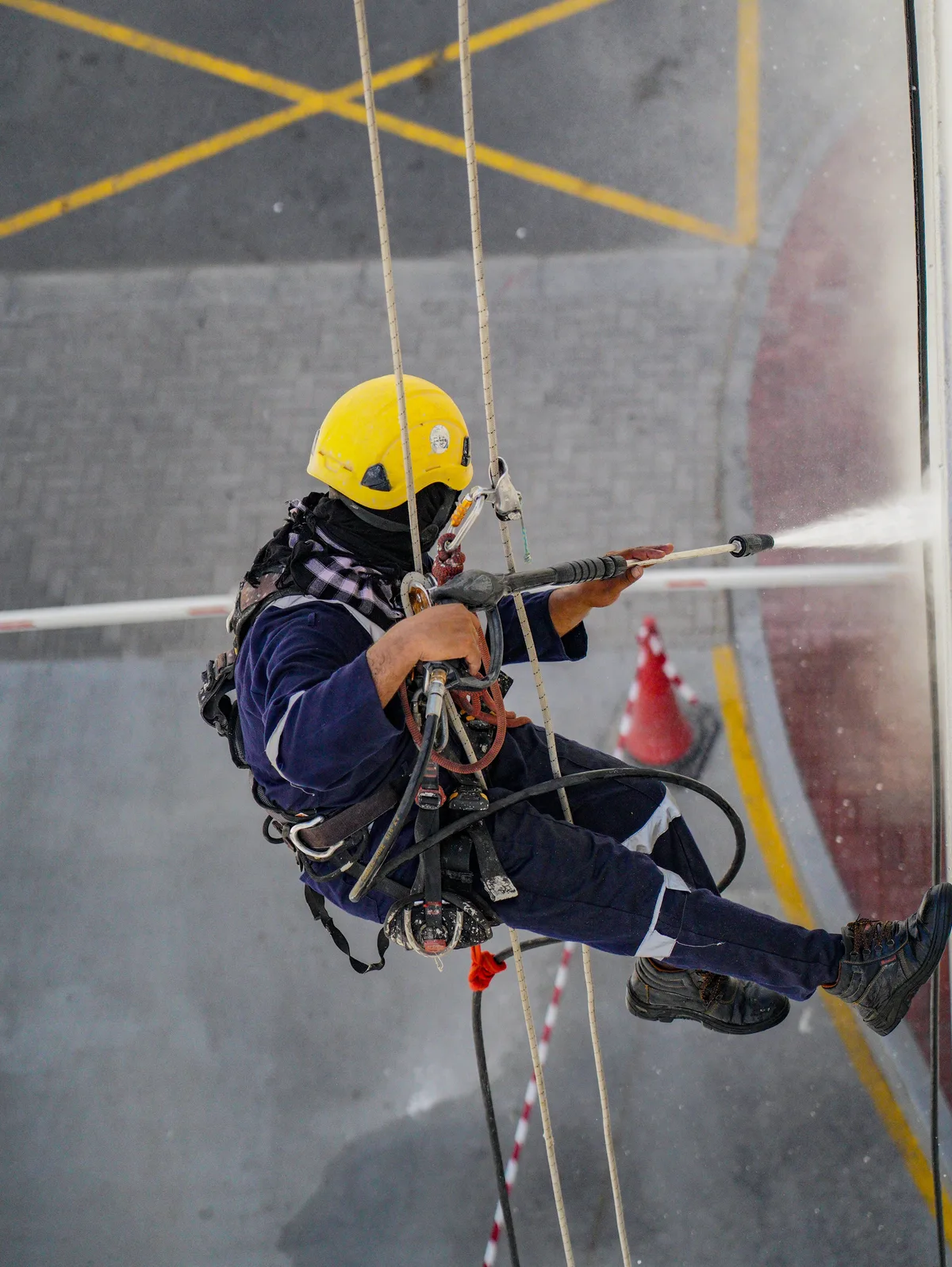
Cleaning a patio, driveway or garden furniture is something you can do well yourself. Facades, roofs, work at height and large business sites are a different matter. A facade can absorb moisture or lose mortar joints if the jet is too hard, and working on a ladder with a pressure washer is dangerous.
👷 For cleaning facades, roofs and gutters, or for work at height, call in a facade or roofing specialist. They work with the right pressure, products, scaffolding or rope access and know how to protect a facade after cleaning. If you are unsure about an outdoor socket, have a qualified electrician check it.
| Situation | Advice |
| bicycle, garden furniture, no power point | HPS20-24 cordless pressure washer |
| small patio and occasional use | HPC120A pressure washer (1500 W) |
| patio, driveway and car | HPC150A pressure washer (2000 W) |
| large patio, frequent use | HPC170AI pressure washer with induction motor |
| intensive and professional use | HPC210BI pressure washer (3500 W) |
| daily on location with a trolley | HPC180BI-CRT pressure washer with trolley |
Curious about the brand behind these machines? Read our brand blog on Stalco.
For a patio, 120 to 150 bar with around 400 litres per hour is more than enough. Use a patio brush for an even result.
Yes, with a wider spray angle and at a sufficient distance. Do not spray close to paint, rubber seals and stickers.
For frequent and long use, yes. An induction motor is quieter and wears less. For occasional use, a brushed motor is fine.
It can with a hard jet from close by. Spray at an angle, use a patio brush and refill the joint sand after cleaning.
Test on an inconspicuous spot first with low pressure. Some natural stone is sensitive. If in doubt, ask a professional.
At Saniso, the online store for DIYers and professionals, you will find tools, materials and personal protective equipment for your job.
In doubt about the approach? Feel free to call in a professional.
Saniso – Build your home with Saniso.
Share:
Install multilayer pipe and press fittings yourself or call in an installer? What you can do yourself, how pressing work...
Cement, hybrid or epoxy grout? CG1, CG2, W, A and RG explained according to EN 13888, and which grout to choose for wall...
From bath to shower: how to go about it. Shower tray or walk-in shower, drainage, waterproofing, a step-by-step plan and...
Combination pliers, side cutters or long nose? Buying guide with sizes, locking, circlip and VDE pliers, plus tips for w...